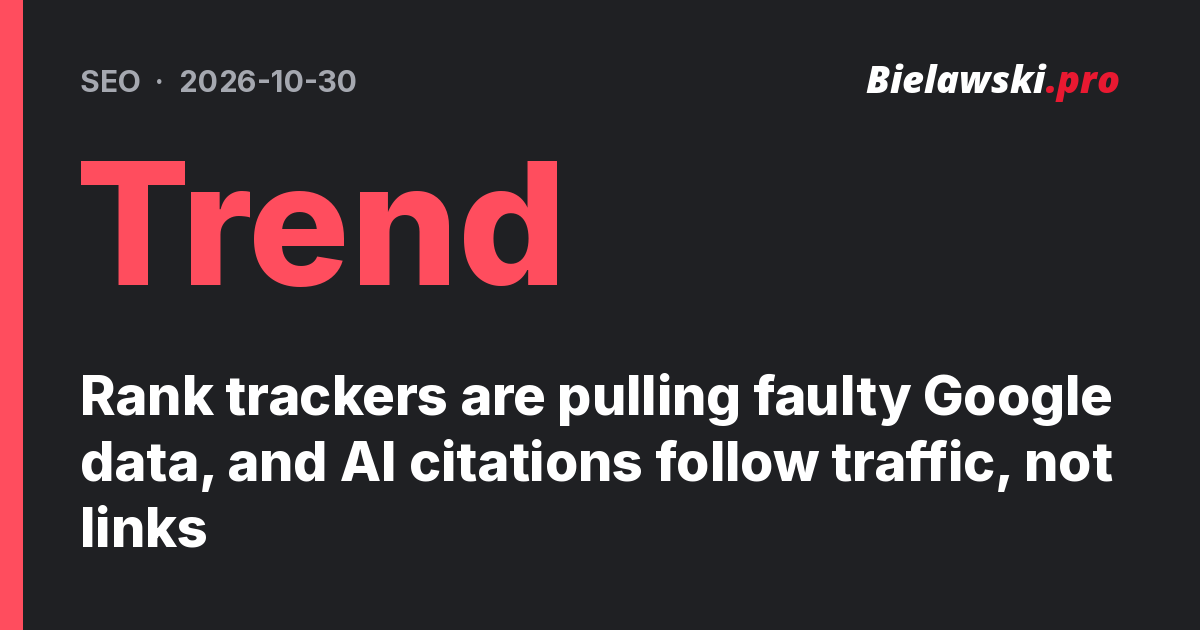
Rank trackers are pulling faulty Google data, and AI citations follow traffic, not links
Over recent weeks, several sources have confirmed that some of the Google results pulled by tools are incomplete. At the same time, new data shows that real traffic correlates with AI citations more strongly than domain strength does.

Signal in the data
Independent sources on this topic: 2 in the last week, 4 in 30 days, 5 in 90 days. We have tracked it since 2013-06-05; 13 claims in our database in total.
Number of independent sources per week (last 12 weeks).
What is happening
Rank tracking tools admit that not every Google result they pull can be trusted. Some results pages come back incomplete, missing the usual URLs, which then reappear on the next check.
Between 13 September and 9 October, this affected 8.0% of the results pages checked (Nozzle). Another vendor, which re-fetches such results before storing them, puts the figure at a similar level of about 8% a day (SEOmonitor).
Where sources agree
Sources agree that the problem is real and not limited to a single tool. Vendors differ only in how they handle it: they discard the result, fetch it again or store it as is.
There is also agreement on a second point. Organic traffic and Google rankings are more closely tied to whether a page keeps its AI citations than Domain Rating and link counts are (Ahrefs).
Where they differ
Estimates of how much of the data is contaminated vary. One estimate puts it at 5-20% of results (Ahrefs), a much wider range than the 8% figure mentioned above.
There is also no agreement on how to test AI visibility. Results from the API match ChatGPT citations more often at the domain level than at the page level, so you need to monitor both.
What to do about it
Don't react to a single ranking jump in your rank tracker. Before you change a page, check whether the same shift shows up in Google Search Console.
If you care about AI citations, work on the traffic and rankings of specific pages. Domain strength alone won't keep a citation for long.
Our take
Rank tracker data is now noisy enough that a single measurement can mislead you. Your own Google data and traffic are a better point of reference, and traffic also turns out to be the best predictor of stable AI citations.
Confidence: medium - several vendors confirm the scale of the problem, but estimates range from 5% to 20%. We will change our view if: Google stabilises the results it serves to automated requests, or vendors show that the share of faulty results drops close to zero after re-fetching.
Sources
- Ahrefs Blog, 2026-10-30: How Stable Are AI Citations? 10 Things We Learned Tracking 37,500 Citations
- WhitePress® Global, 2026-10-29: Perché il tuo sito non è tra le fonti AIO? Analisi su 5.000 query italiane.
- Search Engine Journal, 2026-10-23: How Rank Trackers Say They Handle Suspect Google Results
- Goldie SEO Tips, 2026-10-22: How to Rank #1 in Perplexity SEO
- Search Engine Journal, 2026-10-20: I Tested DeepSeek’s New Search Api, Here’s How It Ranks And Scores Websites
- Search Engine Journal, 2026-10-18: OpenAI's API Only Partly Matched ChatGPT's Citations, Paper Finds